
Saving Electricity home

As seen in Newsweek, InfoWorld, and everywhere else.

Michael Bluejay's home page | Email me

Saving Electricity

On this page...

Lighting

Saving Electricity 101:

Start Here
How much it costs / how they charge
What's a Watt / Kilowatt?
How much energy stuff uses
How to measure electrical use

Mr. Electricity is your guide to saving energy in your home.


If you like this site, you might also like some of my other sites:

Battery Guide

Which battery is best? We cover rechargeable and alkaline batteries to show you what's hot, what's not, and the best way to charge them. (visit now)

Cheap Airfares

How to find the
Cheapest Airfare

Everything you wanna know.

(Visit now...)

Ben Folds Five

The rise and breakup of the world's greatest piano pop band.

(Visit now...)


How to
Buy a House

Step-by-step guide for first-time homebuyers.
Visit now...

The Military Budget as Cookies

This excellent animation from TrueMajority shows in graphic detail (using Oreo cookies) how ridiculously, large the military budget is, and how we could solve many domestic problems with a modest 12% cut. A must-see. (watch it now)

How to Not Get
Hit by Cars

An illustrated guide for bicyclists. Might save your life.

(Visit now...)

I'll cry if you don't link to me.

MichaelBluejay.com

How to save electricity on lighting


Use compact fluorescent light bulbs (CFL's).

If you know only a little about CFL's, you've probably heard that they save a little energy but they contain a lot of toxic mercury. But the truth is, they save a whopping amount of energy, and the mercury scare is way overblown. On this page I'll give you the lowdown on CFL's in great detail.

I first recommended CFL's on this site way back in the 1990's, when they were rare. It was kind of neat back then to let people in on a big secret. It's not such a secret any more, but I'm glad people are saving energy with CFL's.

To understand why CFL's are a big deal, we first need to see why regular lightbulbs are so lame. Environmental Defense has the best explanation of what's wrong with regular light bulbs:

"Though we call them light bulbs, traditional incandescent bulbs are actually small heaters that give off a little bit of light--something you know if you've ever touched a bulb that's been on for a while. These bulbs were technological wonders when they were patented in 1880, but today they are inefficient dinosaurs. They waste energy and money, and they are responsible for millions of tons of global warming pollution."

Compact fluorescent light bulbs (CFL's) are the opposite -- they create mostly light and give off only a little bit of heat. They use 70% less electricity than regular light bulbs, since most of the electric you put into them is used to make light, not heat.

Here's are the benefits of CFL's:

  • Use 70% less energy than regular light bulbs.
  • Last about 10 times as long as regular light bulbs.
  • Produce similar light as regular light bulbs (nothing like old-style fluorescents).
  • Cost as little as $1.50.
  • Don't generate ridiculous amounts of heat (which you would have to pay to remove with AC).

And here are the downsides:

  • Most of them can't be used with dimmer switches. (Some can; check the package.)
  • Cheap ones burn out really quickly. Buy name brands and/or bulbs with a warranty.
  • They start dim and take a minute or two to reach full brightness.
  • They contain a tiny amount of mercury, which would be an issue if you break a bulb and you're careless about how you cleaned up a broken bulb.

CFL's are such a big deal that Australia is making them mandatory. They're doing this to save energy, because saving energy reduces pollution.

Let's start out by looking at the savings you get with CFL's. Right off the bat, you save 70% on energy as soon as you screw them in. Here's a calculator to demonstrate:

Number of bulbs

Wattage (original)

Hours on per day

Cost of electricity*

*

*Rates are averages for an area. Yours may differ. Check your bill.

Monthly
Yearly
10 years

Cost with old bulbs:

$
$
$

Cost with CFL's:

$
$
$

Savings:

$
$
$

And that's just the electricity savings. Since a good CFL lasts 10 times longer than an old-style bulb, that's a lot fewer bulbs to buy. This is especially important for large commercial applications, where the cost of labor to constantly replace old-style bulbs can be significant.

But there's yet more savings. Since CFL's run cooler than old-style bulbs, you'll spend less money to cool your home or office. (But don't think that this means you should use regular lights in winter; sure they create heat, but they do so inefficiently. When you need to add heat to your home, light bulbs are the most wasteful way to do it. Short answer, CFL's are best no matter what the season.)

To figure your electricity savings manually use this formula:

Watts  x  Hours Used


   x  Cost per kilowatt-hour = Total Cost

1000

For example, let's say you replace ten 60-watt bulbs with ten 15-watt CFL bulbs. That saves you 45 watts per bulb, or 450 watts for all ten. Let's say all your lights were on for six hours a day, five days a week. That's thirty hours a week, or about 1500 hours a year. So your 450 watts savings times 1500 hours a year = 675,00 watt-hours. Divide by 1000 and you have 675 kilowatt-hours (kWh). If you're paying 15¢ per kilowatt-hour, then you'll save $101.25 a year.

If you don't like my calculator there's also a calculator at EnergyStar.gov.


How to buy CFL's

When you buy CFL bulbs the package will be labeled to show you how many watts it's equivalent to. For example, a 15-watt CFL bulb package will say something like "60 watt equivalent". They have to say that otherwise people would look at the package and think, "15 watts? That's not nearly enough light!" But it is, because a 15-watt CFL bulb puts out as much light as a standard 60-watt bulb.

Although CFL's generally last for years longer than regular bulbs, the cheap kind can burn out quickly. I therefore recommend buying either name-brand CFL's, or at least ones that come with a 5+ year warranty.

If you're in a super-cold environment, note that most CFL's run dim in very cold temperatures, and most won't run at all below 20°F. (Paralite makes some they claim will work down to minus 20°F.) If you're using them outside as floodlights, then make sure you get the kind that are labeled for cold-weather use. One reader notes that he put a $10 bug light sleeve around the light which acted like insulation, and kept the light just warm enough that it would work.


The great mercury scare

I can't really broach this subject without mentioning where the scare warnings have been coming from: Republicans who want to fight conservation. The reason this is significant is that Republicans have fought against pollution controls and championed the "rights" of polluting companies at nearly every turn for years. So how is it that they're suddenly so concerned with the mercury in CFL's? Is it because they suddenly want less pollution, after decades of acting the opposite way? No, they oppose CFL's because CFL's save energy, and because environmentalists support them. That's all the reason right-wingers need to oppose them. They simply need some excuse, and mercury happened to be convenient. Really, we're supposed to believe that after years of blocking every effort to reduce pollution, the Republicans are suddenly eager to save Americans from toxic substances? Please!

Think I'm exaggerating? Here's the proof. Rep. Ted Poe (R-TX) took the floor of the House to blast CFL lightbulbs and opened up with this flabbergasting statement:

"Congress passed an energy bill which should have been called the 'Anti-America NON-Energy' Bill because it punishes Americans for using energy, rather than finding new sources of affordable energy."

There you have it. Any attempt to reduce our energy use isn't just unnecessary, it's supposedly anti-American! And reducing energy use is tantamount to punishment. Punishment! Since Poe is an unabashed enemy of conservation, is it any freaking wonder that he opposes energy-saving light bulbs?! Is it any surprise that he will bring up any possible defect he can find in CFL's in order to further his anti-conservation agenda?

It gets richer. In Poe's mind, all we need to do is magically find some new sources of affordable energy. And what do you think he has in mind? Why, drilling the Artic National Wildlife Refuge and America's beaches for oil, for starters, something Republicans have been eager to do for years.

Anyway, when Poe has made his anti-environmental agenda so clear and plain, are we really supposed to take him seriously when he starts frothing about the environmental calamity posed by mercury in CFL bulbs? Not.

With that necessary context out of the way, let's look at the actual risk. First of all, there is no risk as long as the bulb doesn't break. You'd think that would be obvious, but some of the hysteria surrounding CFL's is coming from pages that say that just having CFL's installed in your home is "killing you slowly" -- which is absolutely nonsense.

Another idea being bandied about is that the use of CFL's is resulting in a lot more mercury getting into the environment, in general. Not true, because power plants put out tons of mercury. They put out more to power the bulb, than is contained in the bulb. (Ohio EPA)   And if you're using old-style, energy-wasting bulbs, then that means even more mercury being put into the air. So using CFL's dramatically reduces mercury emissions at the power plant. And by the way, to keep mercury out of the landfill, every single Home Depot and Ikea take unbroken CFL's to recycle them.

Next, let's put the amount of mercury in perspective:

If a bulb does break, you just take some simple steps to minimize your exposure when cleaning it up. You certainly don't have to call in a hazmat team. One woman got bad advice that she needed to do just that, and the anti-CFL folks have been having a field day with that one, not admitting that the advice this person received about employing a hazmat team was wrong.

Let's also remember that tubular fluorescents have been used in commercial and office buildings for decades. This is not a new technology at all. Why have the Republicans been silent about the millions of fluorescent tubes that have been in use over the last century? Good question.

All that said, there should be a warning on the package. Really, anything that's a potential mercury hazard should be labeled. I believe it's nothing to worry about as long as you take the easy recommended steps to clean up any broken bulb, but those steps should be included in the product. And I don't think the mercury in the bulbs is a good reason not to use them -- it's just not that big a deal.

More on this:


Other ways to save on lighting energy


Install a skylight.

Using natural lighting saves a bunch of energy and produces a much nicer environment besides. Modern skylights are available which let in only the light and not the heat.


For outside lighting, install a motion sensor that turns the lights on automatically when somebody walks up, and turns the lights off automatically after 1-5 minutes.

Security light fixtures start at $25 at home improvement stores like Home Depot.

Exercise #6: You buy a security light for $20. The light used to be on all night, for 12 hours each night. Now it's on for about an hour a night. You're using two 75-watt bulbs in the fixture. How long does it take for the security light to pay for itself? (assume electricity costs 11¢/kWh) (see answer)


Install motion-sensing switches to automatically turn lights on and off throughout the house.

You can buy motion-sensing wall switches for as little as $10 at a home improvement store.
.


For any light that you want to be on all night (e.g., stairways), replace the bulbs with the lowest wattage bulbs you're comfortable with.

Replacing 75-watt bulbs with 15-watt bulbs reduces energy usage by 80%. Replacing them with CFL's or LED lights saves even more.

Exercise #7: How much do you save in a year by replacing a 75-watt bulb with a 5-watt bulb, for a light that's on 24/7? Use 11¢/kWh for the cost. (see answer)


For lights that you want on all night which are in areas that get some sunlight, buy a screw-in light sensor.

They'll turn off automatically in the morning and then turn on automatically at night. My local home improvement stores sells these for $4.50 ($8.50 for an outdoor version). You just screw the special socket into the existing light socket, then screw the light bulb into the special socket.

Exercise #8: How long does it take for one of these $4.50 devices (indoor version) to pay for itself, assuming you were using a 60-watt bulb, paying 11¢/kWh for electricity, and saving 12 hours per day of light use? (see answer)

You can also make lamps or other devices go off during the day and turn on at night by using a plug-in light sensor ($6). You plug the appliance into the sensor, and then plug the sensor into the wall. If you're handy with electrical wiring, you can mount a light sensor to a wall (like you'd mount a light switch or electrical outlet). Wire-in sensors are around $10.


Turn off lights when you're not using them, even for just a few minutes.

The idea that lights use extra electricity to start up is a myth. You'll save electricity every time you turn the lights off, no matter how short the OFF duration, and whether they're regular lights or fluorescents.

You might have heard that you wear out your lights quicker by cycling them off and on, but that effect is so small it's not worth worrying about, and you can safely turn your lights off every time you leave the room, no matter how short the duration. If you feel you need to obsess over this (as evidenced from all the email I get about the subject) then see my answer below about fluorescent cycling costs.


Replace fluorescent magnetic ballasts with electronic ones.

For long-tube fluorescent lighting (as opposed to screw-in compact fluorescents), an old-style magnetic ballast might use 100W to power two 40W tubes, while an electronic ballast might use only 60W. Also, the electronic ballast eliminates flicker and usually eliminates hum. They also generate less heat, which saves additional money on cooling.


Use LED holiday lights.

LED Christmas lights use 80-90% less electricity than standard holiday lights (which use 25 watts in a typical 50-bulb strand). LED lights also generate much less heat, so they're less likely to catch your Christmas tree on fire. Also, you can put a few strands of white lights on the ceiling and use it as mood lighting.

LED holiday lights aren't quite as bright as standard bulbs, and the light they produce is brilliant white instead of normal yellowish light, but that's fine with us to get the 90% electricity savings. (And blue, yellow, and red are also available.) Another advantage is that the LED's are virtually indestructible -- they don't burn out like normal bulbs (not for about ten years, anyway), and they're not fragile like normal holiday lights. I actually unsuccessfully tried to crush one by standing on it on a concrete surface. I broke the decorative casing but was unable to break the LED bulb itself -- it still shone when I plugged it back in.

Inirgee sells a nice variety of LED lights in a variety of colors: 120V holiday light strings, and 12V holiday light strings to be powered from a battery. Notably, most of the products carry a lifetime warranty.

We have a separate page about rewiring Christmas lights to run off batteries.


LED primary lighting: Not yet ready for prime time

LED's would be great for primary lightning except for a few things:

  1. They're not nearly bright enough to light up a whole room, unless you used a bunch of them.
  2. Most models put out a cold, bluish light, rather than the warm, yellowish light of a regular bulb.
  3. They're crazy expensive.

Most online stores don't even bother to tell you how bright their LED bulbs are, in either lumens or incandescent watt equivalents, because they probably figured that if you knew how dim these bulbs were there's no way you'd buy them. An exception is C. Crane, who is to be commended for providing this info right up front. Unfortunately, the biggest bulb in their catalog is only 200 lumens. Compare that to a traditional 60-watt bulb (or a 15-watt CFL) which gives off about 850 lumens of light. So you could spend $60 to get the equivalent of a 14-watt bulb.

The problems with LED's may be solved in a few years, but not yet. Yes, I know Enlux makes a 65-watt equivalent that produces warm light. The problem with it, besides its $90 (!) cost, is that it uses 22 watts, more than a CFL.

LED's are good for accent lighting, night lights, and decorative lighting, just not primary lighting. I use LED Christmas lights as mood lighting when I don't need a whole lot of light. I hung a couple of strands from hooks aroundthe perimeter of my ceiling. Yeah, the note that came with the lights said "This seasonal use product is not intended for permanent installation or use," but I guess I live on the wild side.

Commercial users might like LED bulbs because they last nearly forever -- 50,000 hours of use. In an installation with lots of bulbs and where they're hard to reach and the labor cost of replacing them is high, LED's might be a good alternative. Commercial users will also want to check out the products at Residential Landscape Lighting.


Below are questions I've received and answered about how saving electricity on lighting.

What do you think of the LongLite product that says it reduces lighting energy by 10%? --Feb. 2007

I think it's useless. Why would you cut your energy use by only 10% when you can get compact fluorescents and cut it by 75%? "Oh, but this product also makes the bulbs last three times as long." Big deal, compact fluorescents last ten times as long.

Go with compact fluorescents.

Our plant has a combination of high pressure sodiun and mecury halide light fixtures. Currently they are on 120V circuits. Each fixture draws 4A on 120V, but can be wired 277V and would draw 1.7A. I calculate that on 120V the fixture uses 120 x 4 = 480watts, and on 277V the fixture uses 277 x 1.7 = 471watts. This is a 9 watt savings per fixture. We have 60 of these fixtures in the plant, so 60 x 9 = 540 watt savings. We run the plant one shift, 5 days a week, so if I assume the lights are on 10 hours a day for 250 days a year, thats 2500 hours and we would save 540watts X 2500 hours = 1350000 watthours, or 1350kwh per year. Electrical cost here is about $0.10 per kwh, so by my calculation we would only save $135 per year. Is my calculation correct? --Mark Jones, Georgetown, KY, Jan. 2005

Yes, you got the math exactly right. It's exactly this kind of calculation that I hope to show my readers how to do.

I caution you though that the savings are so small (<2%) that you might wind up not seeing any savings at all. There could be a margin of error for various reasons.

Are 34W fluorescent tubes interchangeable with the 40W tubes? Ditto for a T8 32W tube with a T12 40W tube when used with an electronic ballast? --Peter Yee, Oakland, CA, Jan. 2005

Usually it's fine to swap a 40W tube with a 34W tube, but some ballasts can overheat with a 34W tube installed. Check the ballast to see if it says it's rated for 34W tubes, and if it doesn't then check with the manufacturer of the ballast. In a worst-case scenario you could replace the existing ballast with one you buy specifically because it's rated for 34W.

32W T8's are another matter -- they require ballasts made just for them.

The main risk of using a mismatched tube/ballast is that the life of either or both can be shortened. There's also the possibility that the ballast could catch fire.

Since I get a fair number of questions about fluorescent lights here are some other resources:

We have fluorescent lights in our building hallways that use two tubes. A neighbor insists that if we just use one of the bulbs we would save electricity. However, I once read that the fixture will continue to draw the same amount of electricity regardless of whether you are just using one bulb. Who is right? --Liam, NYC, Jan. 2005

I'm amazed at all the bizarre misconceptions people come up with. It seems like there's no end to it. Examples include:
  • The idea that it takes more energy to turn on lights or computers than to keep them running.
  • The idea that it takes more energy to turn on the AC when you get home from work rather than to run it all day.
  • The idea that a lamp uses energy even when it's turned off.
  • The idea that a 60-watt bulb uses more energy than a 100-watt bulb.
  • And now this: Someone who thinks that one light bulb uses the same amount of energy as two light bulbs.

Look through this site and you will see that the number of times I've confirmed any crazy idea like this is zero. To answer your question specifically, no, one bulb does not use as much energy as two. One bulb uses one bulb's worth of energy, and two bulbs uses two bulbs' worth of energy.

In 2000 I changed all of my light bulbs to CFL. It cost me about $400 for my house. Within 2 years I was replacing most of them. After 4 years, I reviewed all of my electric bills and found out there was no noticeable difference in how much electricity I used. I started switching back to incadescent bulbs a year ago and now that is all I have. No significant difference in my electricity bill or in kWh used, as I expected. I have consistently used between 600 and 700 kwh per month for the past 10 years. The only things that have made a difference in my power bill is getting rid of my water bed and buying a new refrigerator.

What gives? I thought the CFL were supposed to make a significant difference in power used. I don't get it. Is it possible that some of the CFL bulbs I bought were crap or not what the manufacturers promised? I really would like to understand this. --Marvin Snapp, Mill Valley, CA, Jan. 2005

(1) CFL's really do use about 75% less energy than regular light bulbs. I think you really saved energy but didn't realize it. More on this in a minute.

(2) You either have a bunch of lights or you paid a lot for your CFL bulbs. My home improvement store has CFL bulbs for $2.50 each. You could outfit a whole house for only $40, not $400. Yes, CFL's were more expensive five years ago, but they weren't that much more expensive. Anyone wanting to outfit their home in CFL's today isn't going to spend $400.

(3) You said you started replacing your bulbs after two years, but didn't say whether that was because they burned out or you didn't like the quality of the light. If it's the former, then realize that many CFL's have a multi-year warranty. I definitely recommend getting CFL bulbs with a warranty. I've had good success with my CFL's. I can't remember the last time I bought a bulb, but it was many years ago.

It's easy to verify that your CFL bulbs use less energy than regular bulbs. Put the bulb in a lamp and then plug the lamp into a watt-hour meter. Then try an incandescent bulb. You'll see that the CFL uses 75% less energy. I doubt that a CFL could use as much energy as a regular bulb even if it were low quality or damaged.

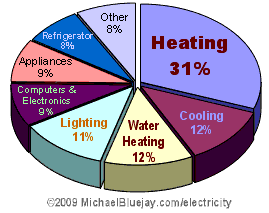
How much difference did you expect to see in your bill? From our How much your stuff uses page we see that lighting accounts for 9.2% of the typical bill. If you were saving 75% of that than you should have saved 9.2% x 75% = 6.9%. If you had been using 700 kWh before, then you'd be expected to save about 6.9% of that, or 48 kWh, so that you'd use a total of 652 kWh. That's right in line with your reported results: between 600 and 700 kWh. I think you were really saving energy and just didn't realize it.

Of course, your own usage affects the outcome (you could be using your lights more or less than 9.2% of your total energy use), and of course your energy use in general varies from month to month. For these reasons looking at the total kWh reported on your bill doesn't really help you see how much your CFL lights were saving you.

Your web site is fantastic and by utilizing most of your tips I have succeeded in reducing my daily average kWh usage from 45 down to 17! I am not exaggerating, I truly reduced my consumption by 60%. My question to you is this: I have six PAR20, 50-watt Halogen bulbs, four of which are on a dimmer, that I would like to change to CFL. Is there a replacement bulb out there for this application? --François Cornwall, Ontario, Canada, Dec. 2004

I can easily believe that you got down to 17 kWh/day because I use only 5 kWh/day myself. Still, it's impressive that you reduced your usage by 62.2%. I don't know how much you're paying for electricity, but at 10¢/kWh you'd be saving over $1000/year, in U.S. currency.

Service Lighting has dimmable CFL's in the PAR style. They might be a little too long for your tastes but that's the nature of CFL's. Incidentally, Service Lighting also has good bulb size charts for both fluorescent and incandescent lights.

I recently bought a 36" fluorescent light that is ready to plug in made by GE. The note said that the replacement bulb should be of specific type and should be 25 watts. I did not like the color of the light but I could not find any 36" lights that were 25 watts so I replaced it with a 30 watt bulb. It appears to work fine, but is there anything wrong by exceeding 5 watts for the bulb in my case? -- Budi Widjaja, Mississauga, Dec. 2004

If the manufacturer says you shouldn't exceed 25 watts, then I wouldn't exceed 25 watts. For a more definitive answer I suggest contacting the manufacturer, since they're the ones who came up with the 25-watt limit.

The lights in my dorm room are fluorescent, I believe 16" tubes. I want to remove these bulbs and find some adapter that allows me to plug in something else. I know there is a step up box in the fixture and I probably will not be able to remove that. -- Chris Weed, Wisconsin, Dec. 2004

Sorry, I generally only answer questions about saving electricity. I don't know about any kind of non-fluorescent light you could put in a fluorescent light fixture, but then again I'm not the right person to ask because this isn't my specialty. In any event, it's rather impossible for me to suggest alternatives since I don't know why you're dissatisfied with your lights in the first place, since you didn't say. If it's buzzing then you need a new ballast (fixture). If you don't like the kind of light it puts out, you can simply get different style tubes.

If a light fixture doesn't say what the watt limit is, how many watts can I use safely? We have a two-bulb light kitchen ceiling fixture. My husband put in two 100-watt bulbs and I am worried about having a fire. -- Linda Davis, Rochester, NY, Dec. 2004

First of all, smack your husband upside the head and tell him it's from me.

Next, if you simply use compact fluorescent bulbs then you won't have to worry about going over the limit, no matter what it is, since CFL's use such a small amount of energy. A 25-watt CFL puts out as much light as a 100-watt incandescent light. Plus, you'll pay 75% less to light your kitchen.

Third, why the heck do you need so much light in the kitchen? 200 watts?! Is the kitchen painted black? Or is it more than 300 square feet?

Next, if you really need that much light in your kitchen, you probably want a better system than putting it all in one spot in the ceiling. That's gonna be harsh. Consider using lamps, or installing a fluorescent panel, or using some other kind of distributed lighting.

Finally, if you (or your husband) are dead set on using incandescent bulbs instead of CFL's and the fixture is unrated, then I wouldn't go over 60 watts each, since that's the lowest I've seen a socket rated for. Of course, you could always replace the socket with a 100-watt socket.

We have 36 Metal Halide lights that we are going to hang in an indoor horse riding arena. If I wire these at 240v they draw 1.3 amps each. If I wire these at 277v they draw 1.1 amps each. This is just 0.2 amps difference. Based on your formula would that be 0.2 amps x 120 volts = 24watts, x 36 lights = 864watt? Is it worth spending approximately $1300 additional dollars to buy and install step-up transformer to jump the voltage from 240v to 277v and how long would it take me to recoup that money? -- Wayne Lawhorn, Richmond, VA, Nov. 2004

There are two mistakes here. As it says on our how they charge you page, the electric company charges you according to how many kilowatt-hours you use, not how many amps you use, so you shouldn't be comparing the difference in amps. Second, when you multiplied amps times volts you used 120 volts for some reason rather than the voltage your lights actually draw.

To figure this properly we have:

  • 1.3 amps x 240 volts = 312 watts for the first light, and
  • 1.1 amps x 277 volts = 305 watts for the second light

That's a difference of 7 watts per bulb. Since you have 36 of them that's a difference of 252 watts for the whole set (0.252 kilowatts).

You didn't mention how much you're paying for electricity, but let's assume it's $0.15. At that rate you're paying $0.15 x 0.252 = 3.8¢ extra for every hour that you run the set. At that rate it would take over 34,000 hours for the 277 lights to pay for themselves.

You will save a lot more money by using fluorescent lighting instead.

How much electricity does a night light take? -- Anonymous, Nov. 2004

Standard night lights use around 5 watts. LED models use about 1 watt. And the "LimeLight" electroluminescent light uses only 0.03 watts!

Remember that the wattage is listed directly on any device you can plug into the wall.

I am a business student at the University of Utah.  For my final project in a statistics class I need to determine how much energy a light bulb uses right when it turns vs. after it has been running for 5 seconds.  It is that initial fluctuation that I cannot figure out how to measure.  I was wondering if you know how, or if you have a device that could measure that very slight fluctuation.  -- Michael Ford, Utah, Nov. 2004

You didn't mention what your point is in trying to measure the surge (i.e., what you're trying to prove), but I'm certain you (or your instructor) is barking up the wrong tree. As I've said many times, for all practical purposes the surge is so tiny as to be irrelevant. You would need special, expensive scientific equipment that you don't have access to and don't know how to use in order to measure the first few milliseconds or microseconds of electrical use of a light bulb. If the energy used were significant then you wouldn't need the equivalent of an electricity microscope to find it.

You can prove this by using a watt-meter to measure the electricity used for one second, then multiplying by 3600 seconds to get one hour's worth of electrical use. Then use the meter to measure the electricity used for one hour, and compare the two figures. You won't see a difference. Any difference you might see is the result of your not turning the meter off at precisely one second after turning it on.

I have a light bulb socket that's labeled "60 watts max". I screwed an adapter into it so now there's two sockets. I want to put a compact fluorescent bulb in each socket, but I want to make sure I don't go over the 60-watt limit. I got some bulbs from IKEA that say they are 11 watts but that they are approximately 60 watts light output. Is it okay to plug two 11-watt energy-saving bulbs into it, even though the "light output" is 60 watts per bulb?  In other words, am I using 22 watts or 120 watts total? Thank you for your time! -- Christine Quigley, May 2004

Good question. You're using 22 watts total, so your lights will be fine. The package is just telling you that each special 11-watt bulb gives as much light as a standard 60-watt bulb. If they didn't say that then no one would buy them, because they'd say, "11 watts?! That's not nearly enough light!"

In fact, though, I'd expect an 11-watt CFL bulb to be equivalent to only a 40-watt standard light bulb. It sounds like the light output claim might be a little exaggerated. The general rule of thumb is to multiply the CFL wattage by four to compare it to a standard bulb. (e.g., 15-watt CFL is comparable to a 60-watt standard bulb, as far as how much light they put out)

Do dimmers on lighting fixtures reduce wattage and save money? -- Eldon McElhiney, Feb. 2003

Yes, they do. But compact fluorescent (CF) light bulbs save even more money. A 25-watt CF bulb puts out as much light as a 100-watt regular bulb. If you used a dimmer on a 100-watt bulb to take it down to 25 watts, there wouldn't be much light.

Most CF's can't be used with dimmer switches. If your fixture is controlled by a dimmer, then either read the package on the CF bulb to find one that works with a dimmer switch, or replace your dimmer switch with a regular switch.

Note that old dimmers were rheostats which did NOT save electricity -- and they generated dangerous heat, to boot. I don't have any idea when they switched from rheostats to the modern solid state variety, but here's how you can see if yours is old or new:

  1. Turn off any device that could automatically turn itself on (like your AC and refrigerator).
  2. Turn on your light at full brightness.
  3. Look at your electric meter and write down how long it takes to make one revolution.
  4. Turn the dimmer down to about 25% brightness.
  5. Check your meter again.

    If it took longer for the meter to spin, then you have a modern dimmer which is saving energy. If the meter speed remained the same, then you have an old-style dimmer and turning it down doesn't save energy. In that case, replace your dimmer with a modern one. You can have an electrician do this for about $40 if you're not comfortable doing it yourself.

    By the way, even though modern dimmer switches save energy when you dim the lights, the lights dim more than the energy is decreased. That means if you make it half as bright, you don't save quite half as much energy. But this is really trivia, and you don't need to worry about it.

If I turn my dimmer to the lowest setting/level (where there's no visible light) is it the same as turning it off? Is the switch turned off in both cases and hence not using any electricity? I find it easier just to turn down the dimmer but am not sure if it's still using electricity when at its lowest level. -- Anita Low, Dec 2003

As long as your dimmer isn't an ancient rheostat (see below) then turning it down so far that you can't see any light is the same as turning it off -- no energy use. (Well, there might be some energy use, but it will be so tiny as to be negligible. If you want to find out for sure you can turn off and unplug everything in your home except the dimmer and see if your electric meter is still moving. But I wouldn't worry about it.)

I read on your site about using LED Christmas lights. What about using LED lights for primary (room) lighting? Does such a thing exist? -- Anonymous, Nov 2003

LED's would be great for primary lightning except for a a couple of things: First, they're not nearly bright enough to light up a whole room, unless you used a bunch of them, which would be prohibitively expensive. (Maybe $100 for enough LED's to replace a 100-watt bulb.) Also, the light they produce is brilliant white, like old-style fluorecents, which is kind of harsh. These problems may be solved in a few years, but not yet. In the meantime, LED's are great for applications like flashlights, bicycle lights, and holiday lights.

We converted our house to energy efficient appliances and use all compact fluorescent lights, together bringing down my monthly usage from a budget of $98 to a high of $52 in August and a low of only $17 in June. We are elated! However these bulbs do not work well to light up the outside when it gets below zero. We burnt out some trying. At our local Menard's they sell a outdoor Regency fluorescent light and fixture that has a solid state on switch allowing it to operate in colder temperatures. However the only bulb option they offer is the old blue look of death. Do you know of any manufactures of solid state outdoor fluorescent fixtures that uses a true white bulb? -- Paul & Julieta Werner, April 2004

First, congratulations on your savings! See, readers, these tips really can save you money. Okay, onto your question. Most CF's won't work below about 20°F. Paralite makes some they claim will work in temperatures as low as -20°F (that's minus 20 degrees), but I don't know what the output looks like. If it's not suitable you may have no other choice but to use standard floodlights for your outdoor fixtures in the winter.

I was wondering, how much will I actually save if I switch from four T-12 fluorescent lights (two 34w & two 40w bulbs) to four T-8 bulbs, run about 60 hrs/week at $.08/kWh. A lot of lighting sales people have different answers, one told me I would save approx. $36 per year with a high power factor electronic ballast, because of lower power consumption, and heat savings factor on A/C.  Please set me straight! -- The Pattersons, June 2003

The Pattersons are talking about those long, fluorescent tube lights that are standard in offices and schools. The short story is that T-12 is old-style and uses the most electricity. Modern replacements are T-8's, and new energy-efficient T-12's. Here's a table to summarize:

Watts
Brightness
Heat
Ballast

T-12

40
Dimmer
Warmer
Electronic or Magnetic

T-12, energy efficient

34

T-8

32
Brighter
Cooler
Electronic Only

In simple terms, the ballast is the socket that you screw the lights into. Old-style magnetic ballasts are known to hum and produce the annoying flicker that can give you "fluorescent headache". Modern ballasts are electronic, quiet, and produce no noticeable flicker.

T-8's are definitely the best choice, because they use the least electricity, produce the most light, generate the least heat, and will definitely be used with a flicker- and hum-free electronic ballast. They also contain less toxic chemicals, and you can also put up to four T-8's into a single ballast. They only reason they still make T-12's is because of all the old magnetic ballasts already out there that won't take a T-8.

So to answer the Pattersons' question: If they're using 148 watts now (40+40+34+34) for 60 hours a week that's 8800 watts a week, or 462kWh a year, which at $0.08/kWh comes to $37.

Switching to four T-8's would mean 128 watts (4 x 32), and at 60 hours a week that's 7680 watts a week, or 399 kWh a year, which at $0.08/kWh comes to $32, a $5 savings, which wouldn't cover the cost of the new lights and ballasts. Still, it could be worth switching just to have brighter light, and to get it without the annoying flicker.

And what about the savings from decreased cooling costs from running lights that don't put out as much heat? While those savings are real, they're notoriously hard to calculate, especially because they vary from building to building depending on insulation, ambient temperature, climate -- and of course it even varies from season to season. A commercial lighting specialist might have access to such estimates but that's definitely out of my realm of specialty.

By the way, the tubes get their names from the number of eighths of an inch in diameter they have. T-12 is (12/8) or 1.5", while T-8 is (8/8) or 1".

Our office is having a disagreement regarding this question. Some say that when you turn on a fluorescent light it takes more electricity to charge it up and we would be better off keeping the lighting on all day. -- Heather Burton, Houston TX, 10-00

Your coworkers are wrong; lights don't require extra measurable amount electricity to start up, whether they're fluorescent or normal. You can stand there and flip the light on and off repeatedly, and it won't make any difference in your electric bill.

Think about it: Even IF a fluorescent used ten times as much energy for the first full second it was on, then basically it's using an extra ten seconds of electricity. So as long as you were turning the light off for at least ten seconds it would pay to turn it off. If you start thinking about it this way then it's easy to see why this myth is wrong.

But remember, in reality, flipping the light on doesn't burn a measurable amount of extra electricity. And that's true of regular lights as well as fluorescents. So it always pays to turn them off. You don't use extra electricity when you turn the lights on, so always turn them off when you're not using them.

Here's another way you could debunk the myth: Go outside and look at the electric meter as someone flips on a fluorescent light. If the light needed a surge of electricity, you'd see the meter spinning blindingly fast for a few seconds, and then slow down again. But that doesn't happen, because lights don't need extra electricity to start up.

By the way, campers have used battery-powered fluorescent lanterns for years. They wouldn't work if fluorescents needed extra power to start up, because if they did then the batteries would be drained right away.

Okay, the fluorescent might not require extra electricity to start up, but every time you turn it on you wear it out a little bit, so that means you should always keep the lights on, right? -- various readers

No. Fluorescents do get worn out by power cycling but the effect is so small it's negligible. So one seems to believe me without seeing an equation, so let's look at the math.

Bulb manufacturers typically test their lights for three-hour periods. (Panasonic tests for 2.5 hours on, 0.5 hour off.) For a 10,000-hour CFL, that's 10,000 / 3 = 3333 starts. If the bulb costs $2 then each start costs 0.06¢. That's not six cents, that's six-hundredths of a cent.

Okay, so let's say you're going to leave the room for 16 minutes, and you're agonizing over whether you should turn the lights off or not. Let's also say you have two 15-watt CFL bulbs. If you turn the lights off then you'll save 16 minute's worth of electricity, which is 30 watts x 16/60 hrs / 1000 wh/kWh x 10¢/kWh = 0.08¢. When you turn them back on you'll use up 0.12¢ of the bulbs' life (0.06¢ for each of two bulbs), for a net cost of 0.04¢. So yes, you're on the losing end by turning off the light instead of keeping it on, but what does this mean in practical terms?

Let's say that four times a day you have the opportunity to turn the lights off when you leave the room for 16 minutes, and you do so. Over a year that costs you 4 times/day x 365 days/year x 0.04¢ = 58¢/year. Now, if you want to obsess over 58¢/year, be my guest.

Consider something else: Every time you leave the lights on to "save" money and you actually wind up leaving for more than 24 minutes, you'll lose money because your electrical costs will outweigh the savings of making the bulb last longer. That will eat into your big $0.58/year savings -- maybe even reversing it.


Battery Guide

Which battery is best? We cover rechargeable and alkaline batteries to show you what's hot, what's not, and the best way to charge them. (visit now)

Cheap Airfares

How to find the
Cheapest Airfare

Everything you wanna know.

(Visit now...)

Last Update: July 2008

©1998-2008 Michael Bluejay, Inc. All Rights Reserved. Unauthorized reprinting is prohibited
All advice is given in good faith. We're not responsible for any errors or omissions. Electricity can kill you; if you're not competent to work on your electrical wiring then hire a professional to do it.
Email me | My home page

If you liked this site, you might like some of my other sites:

Guide to Household Batteries   Finding Cheap Airfare   How to Buy a House   Bicycle Safety   SEO 101: Getting good search engine rankings